
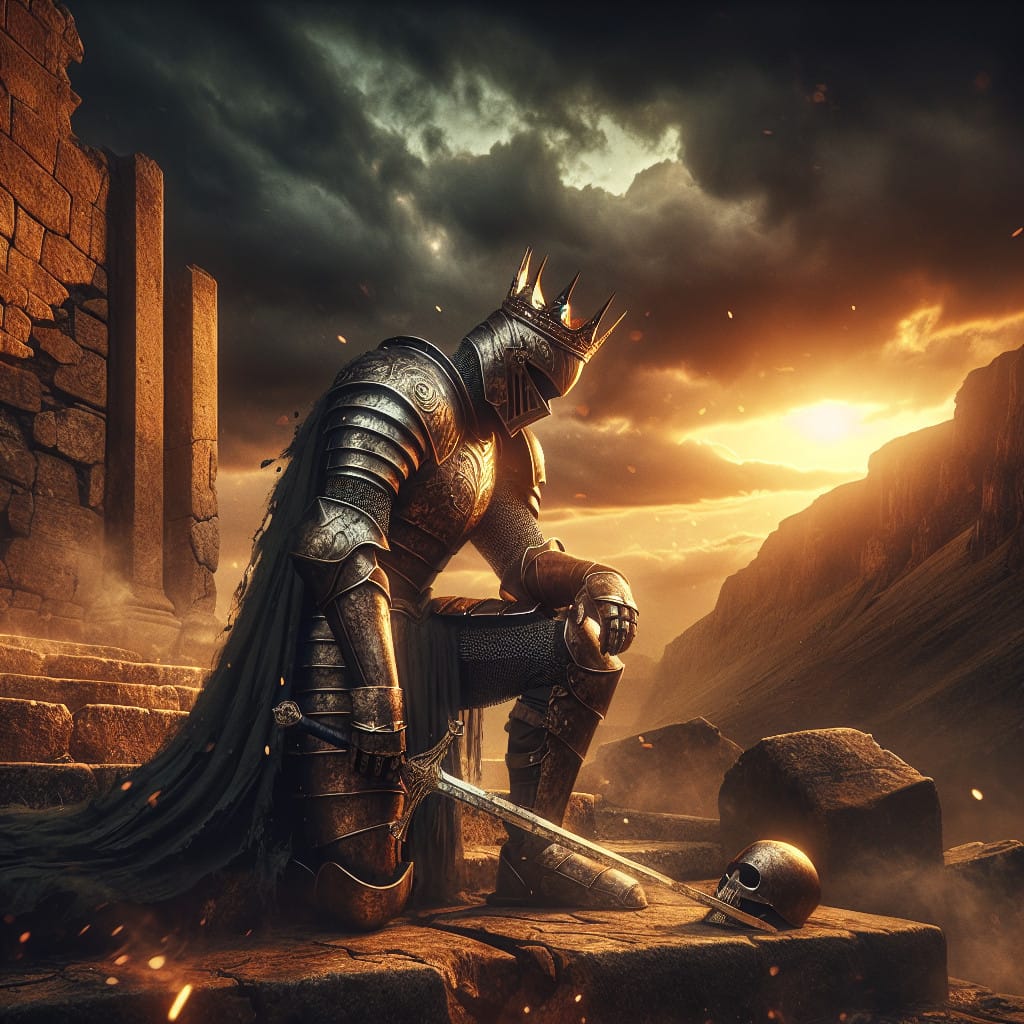
The Fallen Warrior King and the Crown of Dust
There is a silence that exists only after the fall of a kingdom. It is not the quiet of peace, but the hollow echo of a throne room abandoned. In this silence, we find our archetype: the fallen warrior king. His banners are ash, his legions are memory, and his name is a whisper carried on a bitter wind. He sits not upon marble, but upon the cold stone of a ruined keep, and the only crown he wears is one of dust and fractured pride. This is where our chronicle begins, not at the zenith of power, but in the fertile soil of absolute ruin.
The Weight of the Mythic Crown
Every ruler seeks a mythic crown of power. It is not always gold or jewel. Sometimes, it is the crown of absolute authority, of legacy unchallenged, of a peace so hard-won it becomes fragile. The fallen king once bore this weight, believing it fused to his spirit. His mistake was not in wearing it, but in believing it was the source of his strength. The shattering of that crown felt like the shattering of his soul. The myth was not in the object, but in the unbroken path it represented. A path now lost.
To be fallen is to be stripped. Title, army, tribute—all are gone. What remains is the raw material of the self. The calloused hand that once held a scepter still remembers the grip of a sword. The mind that plotted courtly maneuvers can still trace the strategy of survival. This is the king’s first, brutal revelation: his true sovereignty was never over lands, but over his own spirit. The land was merely a reflection.
The Crucible of Broken Stone
Reclaiming lost glory is a fool’s quest. Glory is a fickle sun, here at dawn and gone by dusk. The wise king does not seek to reclaim what was. He seeks to forge what must be. The fallen warrior king rises not to retake his old throne, but to build a new hall from the very stones that crushed him.
His journey is not a campaign of immediate reconquest. It is a silent pilgrimage.
- He must walk the scorched fields of his failures and name each one.
- He must drink from the well of his regrets until the taste no longer chokes him.
- He must gather his scattered weapons, not to arm a legion, but to remember the craft of his own hands.
This is the essence of the warrior resilience tale. Resilience is not a shield that blocks the blow. It is the understanding that a bone, once broken and healed, becomes the strongest part of the body.
The Codex of the Unbroken Spirit
How does one rule from exile? How does one command when no voice answers? The king learns a new hierarchy, written not on parchment but on his will.
- The Edict of the Next Breath: Your kingdom is the air in your lungs. Your first duty is to draw it. Then, the next.
- The Law of the Scar: Each wound is a map of a battle survived. Study it. It holds tactical wisdom no unscratched general possesses.
- The Decree of the Quiet Blade: Power is not noise. True strength gathers in silence, poised, until its moment is undeniable.
This is the internal governance that precedes any external rule. The fallen warrior king becomes a scholar of his own collapse, and from that study, drafts the blueprint for his return.
The Dawn That Rises From Within
There comes a morning unlike the others. The dust of the fallen crown, stirred by a persistent wind, catches a sliver of light. It is not the blinding glare of noon, but the clear, grey light of truth. He sees the dust for what it is: not a symbol of defeat, but the raw ore of a new beginning. The crown was always an idea. He is the vessel. The idea is not dead; it was merely waiting for the vessel to be tempered.
This is the core of every epic fantasy blog of the spirit. The grand spectacle is not the final battle with a dark lord. It is the silent, daily war waged within a man or woman against the seductive call of despair. The rallying of fractured will into a single, unyielding purpose. His march begins not with a trumpet’s blast, but with the simple, earth-shaking decision to stand, and to take a single step forward from the ruins.
He is no longer a king of a place. He is the king of his cause. His realm is the ground beneath his feet, wherever he walks to rebuild. His subjects are the virtues he refuses to abandon: honor, resilience, clarity. His new crown is the invisible, unbreakable circlet of a will tested in the absolute fire and found worthy.
The Chronicler’s Final Creed
Let these words be etched not on stone, but on the spirit:
My throne is my will,
My crown is my resolve,
My kingdom is the next step forward.
I rule from the ruins,
And my legacy is the dawn I choose to build.